
How to Actually Measure Wheel Offset
Wheel offset is the number that decides whether a new set of wheels tucks in nicely or rubs the fender the first time you turn the wheel. It’s stamped on most factory wheels, but the marking wears off, gets covered in brake dust, or simply isn’t there on aftermarket or multi-piece wheels. When that happens, you need to measure it yourself — and the process is more approachable than the terminology makes it sound.
What Offset Actually Means
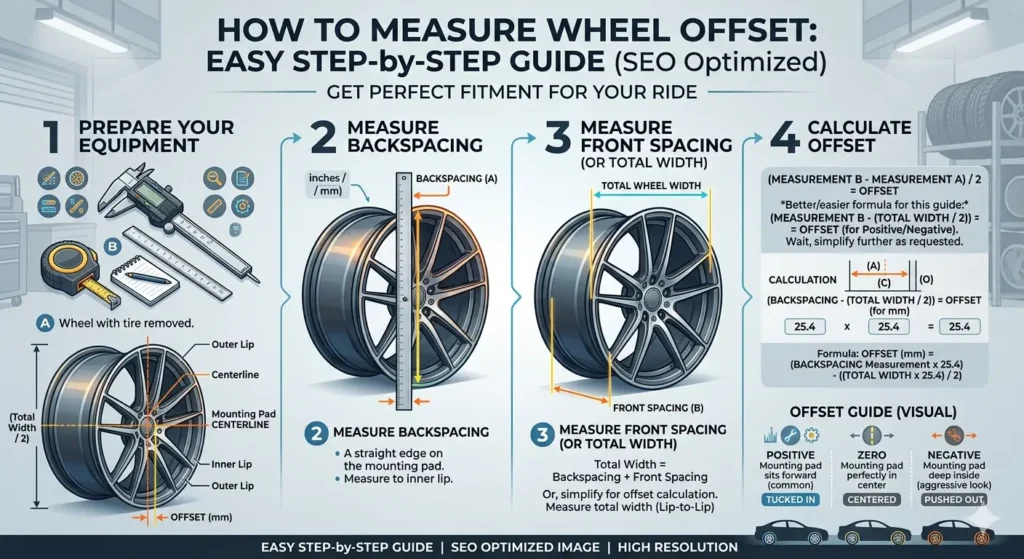
Picture a wheel lying flat, face up. Its centerline is an imaginary line running straight through the middle of its width — if the wheel is 8 inches wide, the centerline sits 4 inches in from either edge. The hub mounting surface, where the wheel physically bolts to the vehicle, usually isn’t at that centerline. Offset is simply the distance between the two, measured in millimeters.
- Positive offset means the mounting surface sits toward the outer (street-facing) side of the wheel — the wheel tucks in closer to the suspension. Most factory wheels, especially on front-wheel-drive cars, use positive offset.
- Negative offset means the mounting surface sits toward the inner side — the wheel pushes outward, away from the suspension. This is the look behind an aggressive, wide stance, common on off-road and lifted builds.
- Zero offset means the mounting surface lines up exactly with the centerline.
The number matters because a change of even 15-20mm noticeably shifts how far the wheel sticks out — enough to cause rubbing against the fender or the strut, depending on direction.
Measuring It Yourself, Step by Step
You’ll need a tape measure or ruler, a straight edge (a piece of wood or a metal ruler works fine), and a flat, level surface.
1. Pull the wheel off the vehicle and remove the tire if you can — measuring with the tire mounted works too, but the tire’s sidewall bulge can throw off your straight-edge reading slightly.
2. Lay the wheel face-down on the flat surface, so the back of the wheel (the side that faces the vehicle) is up.
3. Find the centerline. Lay your straight edge across the back of the wheel so it spans the full width. Measure the gap between the straight edge and the floor. Divide that number by two — that’s your centerline distance from the mounting surface, essentially working from the total width.
4. Measure to the hub mounting surface. With the straight edge still across the wheel, measure down to the actual mounting pad — the flat area where the wheel bolts meet the hub, usually visible as a distinct flat ring around the center bore.
5. Compare the two numbers. If the mounting surface measurement is smaller than the centerline measurement, you have positive offset — subtract to get the number. If it’s larger, you have negative offset. Convert to millimeters if you measured in inches (multiply by 25.4).
Offset vs. Backspacing — Don’t Mix These Up
These two terms get used interchangeably online, but they’re not the same measurement, and confusing them is the most common source of wheel-fitment mistakes.
Backspacing is simply the distance from the mounting surface to the back edge of the wheel — it doesn’t account for the centerline at all, just tells you how far the wheel sits back into the wheelwell.
Offset factors in the wheel’s full width and centerline, giving you a more complete picture of where the wheel sits relative to the vehicle, not just relative to itself.
If you know backspacing and wheel width, you can convert to offset with: Offset = Backspacing − (Wheel Width ÷ 2) — just make sure you’re using consistent units (convert everything to millimeters or everything to inches before doing the math).
Why This Matters Before You Buy New Wheels
Getting the offset wrong when upgrading wheel width is the single most common cause of tire rub, suspension component contact, or wheels that stick out further than intended. If you’re widening your wheels, the offset generally needs to move to compensate — a wider wheel with the same offset as before will push out further on both sides than the original. Most reputable wheel sellers list the offset directly on the product page precisely so you can check compatibility before ordering, rather than finding out after installation.
FAQs
Can I trust the offset number stamped on the wheel? Generally yes if it’s clearly legible, but stampings do wear off or get obscured, so measuring is worth it whenever the number is unclear or the wheel isn’t from the original manufacturer.
Does a small offset change really matter? Yes — even 10-15mm shifts the wheel noticeably, since that distance moves the entire wheel and tire assembly outward or inward by that amount.
Is negative offset always bad for a street car? Not inherently, but it pushes the tire toward the fender edge, so it needs to be paired with adequate fender clearance and sometimes suspension modifications to avoid rubbing.