
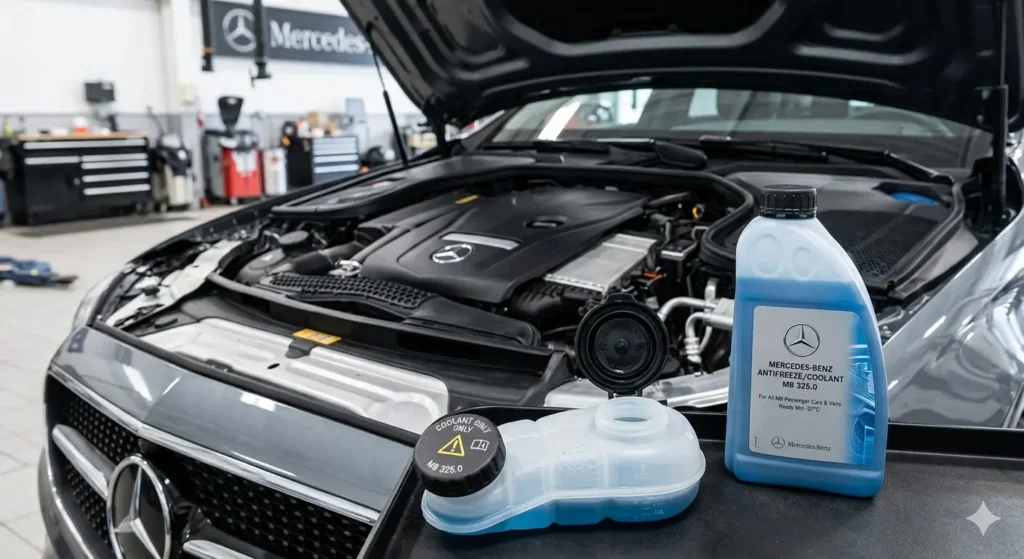
Why Any Green Antifreeze Will Cause Problems in a Mercedes
Walk into most auto parts stores and you’ll find a wall of coolant in blue, green, pink, and orange, most of it labeled “universal” or “all makes.” For a Mercedes, that label is misleading in a way that can actually cost you a cooling system. Mercedes vehicles are far pickier about coolant chemistry than most mainstream brands, and getting this wrong doesn’t just void a warranty claim — it can trigger a chemical reaction inside your own cooling system.
Why Mercedes Coolant Isn’t Interchangeable
Ordinary coolant is a mix of water, ethylene glycol (which lowers the freezing point and raises the boiling point), and corrosion inhibitors. Where Mercedes departs from the pack is in the corrosion inhibitor package and the specific plastics, gaskets, and metals it’s formulated to protect inside their engines. Mixing an incompatible formula with existing Mercedes coolant doesn’t just “not help” — it can cause the additive packages to react with each other, breaking down the corrosion protection and leaving deposits that clog narrow coolant passages.
This is different from most domestic and Japanese brands, where a quality universal coolant genuinely is safe to use.
Knowing Which Spec Your Car Takes
Mercedes has used a few different formulas over the years, and the color on the cap or reservoir is your first clue, though not a guarantee:
- Blue coolant (MB 325.0/326.0) was standard on most models built before roughly April 2014.
- Pink/violet coolant (MB 325.5/325.6, marketed as G40) became the standard on newer production, particularly from around 2015 onward across most car lines.
The only way to be certain which one your specific car needs is the owner’s manual or the fill cap markings — model year alone isn’t a perfectly reliable guide, since the changeover wasn’t identical across every platform.
What to Do If You’re Topping Up on the Road
This is the situation that actually matters day-to-day. If your low-coolant warning comes on and you’re nowhere near a parts store carrying the correct MB-spec fluid, here’s the priority order:
- Plain water — distilled if you have it, tap water if you don’t — is the safer emergency choice over guessing at a coolant. It won’t provide freeze protection or long-term corrosion resistance, but it won’t chemically contaminate the system either.
- Get the correct spec coolant in as soon as reasonably possible and have the system properly diluted and topped off — most Mercedes concentrates need mixing to roughly a 50/50 ratio with water unless you’re using a premixed version.
- Avoid grabbing a “universal” or unlabeled green coolant off a shelf, even in an emergency, unless you have no other option and plan to flush the system properly afterward.
A Low Reading Usually Means a Leak, Not Just Evaporation
Coolant doesn’t disappear on its own in a sealed system. If your Mercedes keeps needing topped up, there’s fluid escaping somewhere — commonly a hose connection, the water pump, or a plastic coolant reservoir that’s cracked with age (a known wear item on several Mercedes platforms). Worth having checked before it becomes an overheating situation rather than a maintenance note.
Bottom Line
Confirm your coolant spec from the cap or owner’s manual before buying anything, never mix an unknown “universal” coolant into a Mercedes cooling system except as a genuine emergency measure, and treat a coolant level that keeps dropping as a leak to find, not a top-up routine to repeat.
FAQs
Can I mix blue and pink Mercedes coolant if I’m not sure which one is in the car? No — flush the system fully before switching formulas rather than mixing them, since the corrosion inhibitor packages aren’t designed to work together.
Is it true Mercedes factory coolant lasts up to 15 years? Many newer Mercedes vehicles do ship with long-life coolant rated well beyond typical service intervals, though this varies by model and it’s still worth monitoring condition rather than assuming it forever.
What happens if I accidentally use the wrong coolant? A single small emergency top-up rarely causes lasting harm, but the system should be flushed and refilled with the correct spec as soon as possible to avoid inhibitor breakdown over time.