
Transmission Fluid Sealer: When It Works and When You’re Just Delaying Inevitable
A small red drop under the transmission tunnel is one of those things that makes every car owner do quick mental math — full rebuild, or is there a cheaper fix first? Bottle transmission sealers exist for exactly that moment, and used correctly, they’re a legitimate first step. Used as a permanent fix for the wrong kind of leak, they’re just a way to spend money delaying a repair that’s coming anyway.
What These Products Actually Do
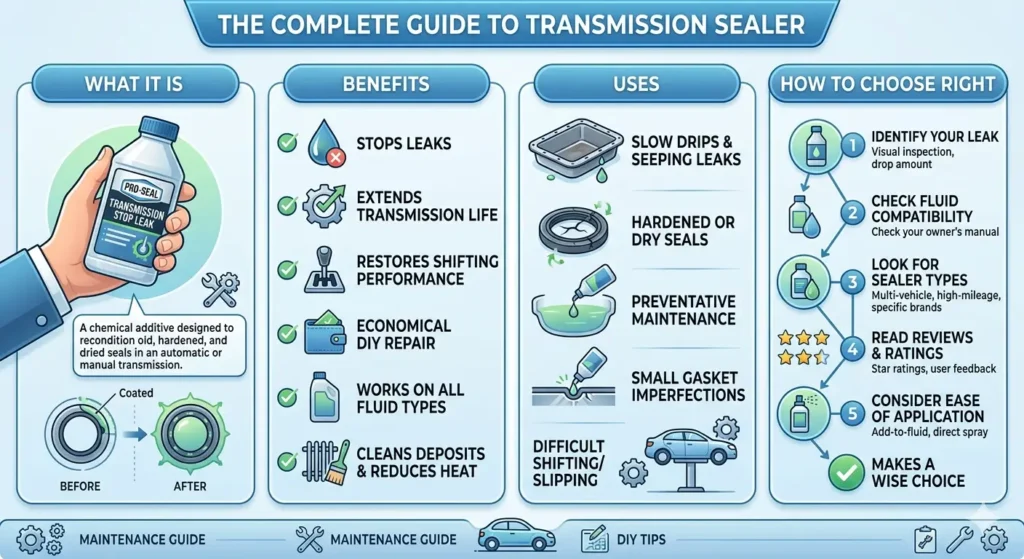
Despite the name, a transmission sealer isn’t patching a hole. It’s a fluid additive — typically a blend of conditioning agents that gets poured directly into the transmission and circulates with the existing fluid. Its job is to soften and swell rubber seals and gaskets that have dried out, shrunk, or cracked with age and heat cycling. As those seals rehydrate and expand slightly, they re-seat against their mating surfaces and stop seeping.
This only works on one category of leak: seals that have degraded from age, not seals or gaskets that are physically torn, a pan that’s cracked, or a bolt that’s simply loose. No additive rebuilds a broken part.
Reading Your Leak Correctly First
Before buying anything, it’s worth fifteen minutes to actually find where the fluid is coming from — guessing wastes both time and the product.
- Wipe the transmission case and pan completely dry, then drive normally for a day or two and check where fluid reappears first.
- A leak at the pan gasket edge often responds well to a sealer, since pan gaskets are a classic slow-dry-out failure.
- A leak at the output shaft seal (where the driveshaft exits the transmission) is also a common sealer candidate.
- A leak that’s a steady drip or puddle rather than a seep, or one you can see actively dripping with the engine off, usually points to a torn seal or cracked housing — a sealer won’t hold that back for long, if at all.
If you’re not sure, a mechanic can pressure-test the system or use UV dye to trace the exact source in a few minutes — cheap insurance before spending on the wrong fix.
Using It Without Making Things Worse
Check your fluid level and condition first. If the transmission is already low from the leak, top it off before or as part of adding the sealer — running low is harder on the transmission than the leak itself in the short term.
Follow the dosage on the bottle relative to your transmission’s total fluid capacity. Overdosing doesn’t work faster; it just risks over-softening seals that were fine, which can create new leaks elsewhere.
Drive it in. Most of these products need normal driving — varied RPM and temperature cycling — for the conditioning agents to actually reach and work into the seals. Sitting in the driveway won’t do much.
Give it time before judging results. Seals typically need anywhere from a few days to a couple of weeks of driving to fully re-swell. Checking the next morning and declaring it a failure is premature.
The Honest Limitation
Even on a good-candidate leak, a chemical sealer is managing a symptom of aging rubber, not reversing it. It buys time — often months, sometimes longer — but the seal is still older and will eventually need physical replacement. If the transmission is otherwise healthy and shifting well, that traded time is genuinely useful. If you’re already seeing other signs of wear (slipping, delayed engagement, burnt-smelling fluid), the leak is probably the smaller problem, and a sealer is not addressing the bigger one.
Bottom Line
Transmission sealer is a legitimate, low-cost first move for a slow seep from an aging gasket or seal — not a substitute for diagnosing what’s actually leaking, and not a fix for anything torn, cracked, or actively dripping. Spend the fifteen minutes finding the source before spending on the bottle.
FAQs
Can I use transmission sealer with any type of transmission fluid? Most are formulated to be compatible across ATF types, but check the label against your specific fluid — mismatches can affect performance.
Will it fix a leak from a cracked transmission pan? No — that’s a physical defect, not a dried-out seal, and needs pan repair or replacement instead.
How long does the effect typically last? It varies with how far gone the seal was, but a few months to over a year is common before the leak either stays sealed for good or slowly returns.