Chinese EV Cars in the USA: Why They’re Everywhere Except Here
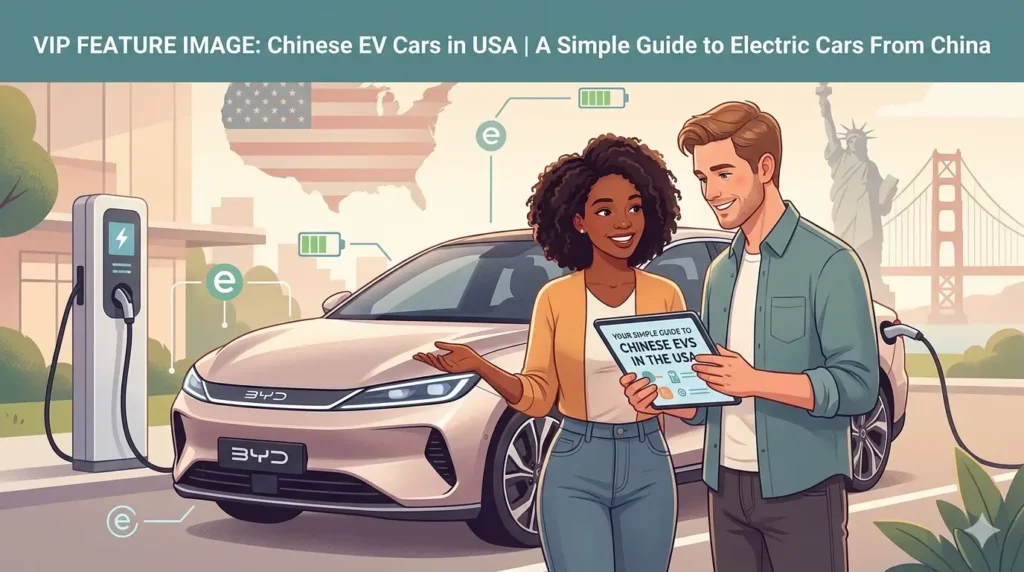
Drive through a major city in Europe or Southeast Asia and Chinese EV brands are impossible to miss — BYD dealerships, NIO showrooms, XPeng badges on cars that look genuinely competitive with anything from Tesla or Volkswagen. Walk through a dealership lot in the United States, though, and you won’t find a single one. That gap isn’t an accident of the market; it’s the direct result of trade policy, and understanding why matters if you’re curious about where the EV market is actually headed.
Here’s what’s really going on with Chinese EVs and the US market — what these brands offer, why they’re locked out, and whether that’s likely to change.
What Counts as a Chinese EV
Simply put, these are electric vehicles designed and built by Chinese automakers. China has become the largest EV market in the world by a wide margin, with domestic manufacturers selling millions of vehicles a year and iterating on new models constantly. Some brands chase rock-bottom prices; others are building genuinely premium, tech-forward vehicles meant to compete directly with Western luxury brands.
Why These Cars Have Built a Global Following
The pitch is straightforward: strong value for the price, aggressive tech features, and competitive range. Many models ship with large in-cabin touchscreens, fast-charging capability, and smart navigation systems that feel a generation ahead of what legacy automakers were offering just a few years ago. Combine that with pricing that regularly undercuts Western and Japanese competitors, and it’s easy to see why these brands have taken serious market share across Europe, Southeast Asia, and Latin America.
The Brands Actually Worth Knowing
BYD is the heavyweight of the group — the world’s largest EV manufacturer by volume, with deep investment in its own battery technology and a lineup that spans everything from ultra-budget hatchbacks to full-size SUVs.
NIO plays in the premium space and is often compared directly to Tesla. Its signature feature is battery-swap stations, where drivers exchange a depleted battery for a charged one in minutes instead of waiting for a plug-in charge.
XPeng leans hard into smart-driving software and advanced tech features, positioning itself as the more software-forward option in the group.
Li Auto targets families specifically, building spacious, comfort-oriented vehicles rather than chasing performance numbers.
Zeekr sits at the premium end, aiming at buyers who want a genuinely luxury EV experience rather than a value play.
| Brand | Known for |
|---|---|
| BYD | Battery technology, scale, affordability |
| NIO | Battery-swap technology, premium positioning |
| XPeng | Smart-driving software |
| Li Auto | Family-focused comfort |
| Zeekr | Luxury features |
The Actual Situation in the US Right Now
Here’s the part that surprises a lot of people: none of these brands currently sell passenger vehicles in the United States. This isn’t a matter of limited dealership presence — it’s a near-total lock-out driven by trade policy, not consumer demand or product quality.
The core reason is a 100% tariff imposed on Chinese-made EVs, first implemented in 2024 and still firmly in place through 2026. A tariff at that level effectively doubles the cost of any Chinese EV the moment it crosses the US border, making it commercially unviable no matter how competitively priced the vehicle is in its home market. BYD’s $8,000 Seagull, for instance, would face a price that’s simply uncompetitive once that tariff gets applied — even before shipping and compliance costs. Some of these brands have said publicly that US entry isn’t viable at all under current conditions.
It’s worth noting that neighboring markets have handled this very differently. Canada also imposed a 100% tariff on Chinese EVs, but in early 2026 struck a deal allowing a limited number of Chinese-built vehicles in at a much lower rate as part of a broader trade agreement — a move US officials publicly criticized. Mexico, meanwhile, has become a genuine foothold for Chinese manufacturers, who are investing heavily in local production facilities there, partly to eventually qualify for USMCA’s tariff-free treatment on vehicles built in North America.
The Reasoning Behind the Tariff Wall
US policymakers have framed the tariffs around three main concerns: protecting the domestic EV industry from significantly lower-cost Chinese competition, addressing worries about state subsidies that let Chinese automakers price below what would otherwise be sustainable, and reducing US dependence on Chinese battery supply chains. Critics of the policy argue it mainly limits affordable options for American consumers; supporters point to the domestic manufacturing investment it’s helped push from companies like Ford and GM in response.
What These Cars Actually Offer, Feature-Wise
Setting the politics aside, the vehicles themselves tend to compete well on a few fronts: large, responsive touchscreens that handle most vehicle functions, fast-charging hardware that cuts down wait times significantly, respectable driving range that keeps range anxiety in check, and over-the-air software updates that continue improving the car after purchase. Design has also moved well past “budget EV” aesthetics — many current models look genuinely premium.
Where This Could Realistically Go From Here
A few paths could change the current standoff. Some Chinese manufacturers are exploring US-based manufacturing specifically to sidestep the tariff, since a vehicle built domestically wouldn’t face the same import duty — though as of 2026, none of the major brands have a functioning US assembly plant up and running. There’s also the “Mexico angle”: companies building production capacity there are betting that USMCA rules of origin could eventually let vehicles cross into the US tariff-free, provided enough of the vehicle is built within North America. Whether that actually plays out depends heavily on how trade policy evolves, and that’s genuinely hard to predict given how quickly the rules have shifted over the past two years.
For now, if you’re in the US and curious about these brands, your realistic options are limited to watching from the sidelines — reading about models sold elsewhere, or looking at how they’re performing in markets like Canada, Mexico, and Europe as an early signal of what could eventually cross the border.
Quick Questions, Straight Answers
Can I currently buy a new Chinese EV in the US? No — as of 2026, major Chinese brands don’t sell passenger vehicles in the American market due to the 100% import tariff.
Why is the tariff so high specifically on EVs? It’s meant to protect domestic manufacturers from underpriced competition and address concerns over state subsidies and battery supply chain dependence.
Is Canada handling this the same way? No — Canada also imposed a 100% tariff but carved out a limited allowance for Chinese EVs at a much lower rate as part of a 2026 trade deal.
Could Chinese EVs eventually reach the US? Possibly, mainly through US-based manufacturing or vehicles built in Mexico under USMCA rules, but nothing concrete has materialized as of 2026.
Which Chinese brand is best known globally? BYD, both for its production volume and its role as the world’s largest EV maker.
Are these vehicles considered high quality? Many current models are competitive on tech, range, and build quality — the barrier to US entry is trade policy, not product shortcomings.