2024 Chevy Trailblazer Full Review of Specs Pricing
The subcompact SUV segment is crowded, and standing out in it usually means picking a lane — either lean into performance, chase maximum value, or bet on tech and styling. Chevrolet’s answer with the 2024 Trailblazer is mostly the latter two: a refreshed, sharper-looking exterior, a genuinely large touchscreen for the segment, and pricing that undercuts a lot of the competition. It won’t win any drag races, but for buyers who want an easy-to-live-with small SUV without a luxury price tag, it’s worth a serious look.
Here’s what actually changed for 2024, how it drives, what it costs, and where it falls short.
What’s Actually New This Year
The Trailblazer picked up a mid-cycle refresh for 2024 rather than a full redesign. The most visible change is up front — Chevy reworked the nose with the bowtie logo now sitting on the grille crossbar, along with updated bumper and foglight housings, giving the whole front end a slightly more aggressive look. Inside, the infotainment system got a boost too, and cruise control along with push-button start are now standard across every trim, including the base model — small changes, but ones that make the entry-level version feel less stripped-down than before.
Engine Options and How It Actually Drives
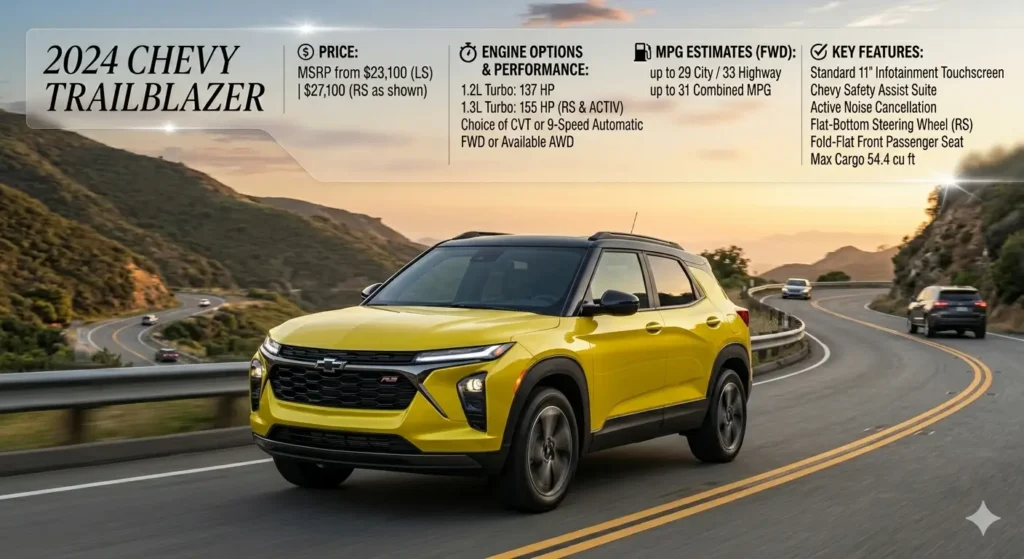
Chevy offers two engines here, both turbocharged three-cylinders: a 1.2-liter making 137 horsepower and 162 lb-ft of torque, paired exclusively with a CVT and front-wheel drive, and a 1.3-liter making 155 horsepower and 174 lb-ft, which unlocks the option of all-wheel drive paired with a nine-speed automatic.
Neither engine is going to impress anyone chasing performance — reviewers consistently note that acceleration feels underwhelming, especially at highway speeds where there’s little reserve power for passing or climbing grades. The ride quality leans firm rather than plush, and the brake pedal feel doesn’t inspire a ton of confidence. That said, handling itself is competent, with modest body roll and decent grip in daily driving. If outright power and athletic handling matter to you, rivals like the Mazda CX-30 offer noticeably stronger engine options — but if you’re mainly commuting and running errands, the Trailblazer’s power is adequate rather than exciting.
Real-World Fuel Economy
Fuel economy is a genuine strength here, particularly on the front-wheel-drive models. EPA estimates put the 1.2-liter FWD version at around 29 mpg city and 31 mpg highway, while the 1.3-liter FWD version does slightly better on the highway at up to 33 mpg. Choosing all-wheel drive brings those numbers down somewhat — figure closer to 26-27 mpg combined — which is worth factoring in if fuel costs matter more to you than winter traction.
Interior Space and Comfort
The cabin punches above its subcompact classification in terms of usable space. Rear-seat passengers get over 38 inches of headroom and close to 39 inches of legroom, which is genuinely competitive with vehicles a size class up — adults in the back seat won’t feel cramped on a longer drive. Cargo space is a standout too, with a fold-flat front passenger seat, a wide rear opening, and flexible configurations that make loading larger or awkwardly shaped items easier than in many segment rivals.
Seat comfort varies noticeably by trim — the base LS gets manually adjustable front seats, while the LT adds power adjustment with the available Convenience Package, and the top Activ and RS trims bring heated front seats and a heated steering wheel into the mix.
Technology and Connectivity
Every trim gets an 11-inch touchscreen, which is unusually large for this price segment, paired with an 8-inch customizable digital driver display. Wireless Apple CarPlay and Android Auto come standard across the board, so connecting a phone takes seconds rather than requiring a cable or a trip through settings menus. Bluetooth, USB ports, and Wi-Fi hotspot capability round out the package — solid tech coverage for a vehicle at this price point.
Safety Features
Standard driver-assist technology is generous for the class: automatic emergency braking, lane keep assist, forward collision alert, front pedestrian braking, and a following distance indicator all come standard regardless of trim. Stepping up to higher trims unlocks adaptive cruise control, rear parking sensors, rear cross-traffic alert, and lane change alert — worth considering if you regularly drive in heavier traffic or do a lot of highway commuting.
Trim Levels, Broken Down
LS is the entry point, delivering the essentials without unnecessary extras — a reasonable choice for buyers who mainly want reliable basic transportation.
LT adds a meaningful jump in features relative to the price increase — tinted windows, keyless entry, and heated mirrors among them — and tends to be the trim most buyers actually walk away with.
Activ targets a more outdoorsy, adventure-oriented buyer with rugged styling cues, while pairing with the stronger 1.3-liter engine.
RS goes for a sportier look instead, with unique styling details, larger wheels, and a more aggressive stance, also built around the 1.3-liter engine.
What You’ll Actually Pay
Pricing starts in the low-to-mid $23,000s for the base LS and climbs into the high-$20,000s range for the Activ and RS trims once options are factored in, before destination charges. That positions the Trailblazer as one of the more affordable choices in its class — a meaningful part of its overall appeal, even with the underwhelming powertrain. Exact pricing varies by dealer, region, and current incentives, so it’s worth getting quotes before assuming any single number.
Where It Wins and Where It Doesn’t
The Trailblazer’s strongest cards are its price, its unusually large touchscreen for the segment, generous standard safety tech, and genuinely competitive interior space for cargo and rear-seat passengers. Where it falls short is engine performance — both available engines feel modest next to some competitors — along with a firmer ride than some buyers will want and interior materials that don’t feel especially premium in the base trims. All-wheel drive is also an added cost rather than something bundled in, which matters if you’re budgeting for a specific configuration.
Getting the Most Out of a Purchase
If performance matters at all to you, the 1.3-liter engine is worth the step up over the base 1.2-liter — the extra horsepower is noticeable in everyday driving. Anyone regularly dealing with rain, snow, or rougher roads should seriously weigh the all-wheel-drive option despite the fuel economy trade-off. Beyond the mechanical choices, compare trims carefully rather than assuming the base model covers what you need, actually sit in the cargo area if you plan to haul larger items regularly, and check for current dealer incentives — pricing on this model tends to move with regional promotions more than some competitors.
The Bottom Line
The 2024 Chevy Trailblazer isn’t chasing performance buyers, and it shouldn’t be judged against sportier rivals on that basis. What it offers instead is real value: strong fuel economy, a genuinely impressive tech package for the price, solid standard safety features, and more interior room than its compact footprint suggests. For daily commuters, students, or families who want a practical, easy-to-drive small SUV without stretching the budget, it’s a legitimately smart pick — just go in knowing the engine won’t be the highlight of your test drive.
Quick Questions, Straight Answers
What engines are available? A 137-horsepower 1.2-liter turbo (FWD only) and a 155-horsepower 1.3-liter turbo, which also offers optional all-wheel drive.
Is all-wheel drive available? Yes, but only paired with the 1.3-liter engine, and it comes at a fuel economy cost.
What’s the fuel economy like? Up to around 31-33 mpg highway on front-wheel-drive models, with all-wheel-drive versions coming in somewhat lower.
What does it cost to start? Pricing generally starts in the low-$23,000s for the base LS trim, climbing from there by trim and options.
Does it come with wireless Apple CarPlay and Android Auto? Yes, standard across all trims.
Which trim represents the best value? The LT tends to be the sweet spot for most buyers — a meaningful features upgrade over the base LS without jumping to the pricier Activ or RS trims.
Is it a good choice for families? Reasonably, yes — the safety tech and genuinely spacious cargo area make it practical, though buyers wanting stronger performance may want to cross-shop rivals.