Choosing an Auto Body and Paint Shop What Actually Matters
A fender-bender or a shopping-cart dent rarely threatens how your car drives. What it does threaten is how the car looks — and eventually, what it’s worth. That’s the gap an auto body and paint shop fills: these shops straighten bent panels, blend out scratches, chase down rust before it spreads, and respray a car until the repair disappears into the original finish.
What These Shops Actually Do
The work splits into a few clear categories, and most shops handle all of them under one roof.
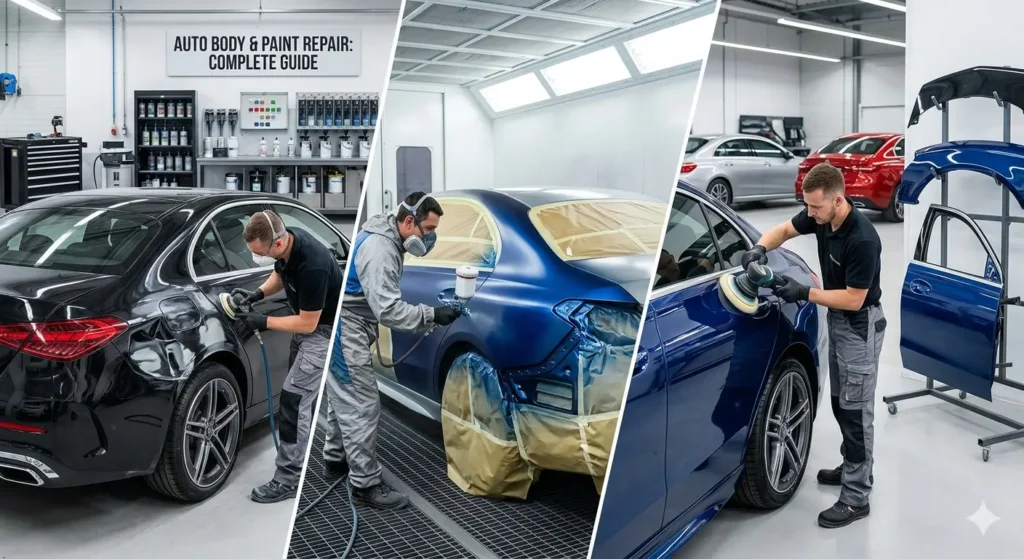
Dent repair covers hail damage, parking-lot dings, and small impacts that haven’t broken the paint. Many of these go through paintless dent repair (PDR), where a technician massages the metal back into shape from behind the panel — no filler, no repaint, and noticeably cheaper than traditional bodywork.
Collision repair is the heavier end of the job: replacing a crumpled door, straightening a frame, swapping a bumper that’s cracked beyond saving. This is where a shop’s equipment matters most, since frame work in particular requires machines that can pull a unibody back to factory measurements.
Paint work ranges from touching up a single scratch to a full respray. Faded clear coat, chipped paint along the hood, and peeling sections near the trunk all fall here, and matching the new paint to the old is where a shop’s skill really shows.
What Drives the Cost
Ask three shops for a quote on the same damage and you’ll often get three different numbers, and it’s rarely random. Labor rates vary by region and by shop overhead. Paint matching gets harder — and pricier — on metallic or pearl finishes that shift color depending on the light. And parts availability plays a bigger role than most people expect: an OEM bumper for a common sedan ships fast and cheap, while the same part for a less common import can add weeks and real cost to the job.
A useful rule of thumb: paintless dent repair on a single small ding often runs well under what a repaint costs, because you’re skipping materials, booth time, and drying time entirely. Once a repair needs filler and paint, though, the price climbs closer to what a full panel repaint would cost anyway — so it’s worth asking a shop directly whether PDR is even an option for your specific damage before assuming you need a full repair.
How to Actually Compare Shops
Get more than one estimate — this is the single highest-leverage thing you can do before committing. A wide spread between quotes usually means the shops disagree on scope, not just price, so ask each one to walk you through exactly what they’re planning to do.
Beyond price, a few questions tend to separate the shops worth trusting from the ones to skip:
- Do they offer a written warranty on the paint and the bodywork, and what does it actually cover?
- Are they certified by your car’s manufacturer or by an industry body like I-CAR? This matters more on newer vehicles with structural aluminum or advanced driver-assist sensors that need recalibrating after repair.
- Will they show you a color match sample before committing to the full job?
- How do recent reviews describe their communication, not just their results — a shop that answers questions clearly during the estimate usually keeps that up during the repair.
Where People Get This Wrong
The most common mistake is choosing purely on the lowest number. A cheap quote sometimes reflects thinner paint, aftermarket parts where OEM would fit better, or a shortcut on prep work that shows up as peeling six months later — not always, but often enough to ask why one quote undercuts the others.
The second mistake is ignoring small damage. A scratch that exposes bare metal isn’t just cosmetic once moisture gets into it; left alone, it becomes a rust spot, and rust repair costs considerably more than the scratch repair would have.
The third is skipping a written estimate in favor of a verbal one. Get the scope, the cost, and the timeline in writing before the shop starts — it’s the easiest way to avoid a surprise invoice later.
The Bottom Line
Most vehicle damage — dents, scratches, faded paint, small rust spots — has a repair path that doesn’t require replacing the car or living with it. The real decision isn’t whether to fix it, but which shop to trust with it. Get a couple of estimates, ask about certification and warranty, and don’t assume the cheapest quote is the best deal until you know why it’s cheaper.
A couple of things people usually want to know:
Paintless dent repair works well on shallow dents without cracked paint, but it can’t help once the paint has split or the metal has stretched too far — at that point you’re back to filler and a repaint. Color matching is genuinely difficult on metallic and pearl finishes because the pigment shifts under different light, which is exactly why it’s worth asking to see a sprayed sample before the shop commits to the full panel. And rust: catching it early, while it’s still surface-level, is dramatically cheaper than waiting until it’s eaten through metal that then needs replacing rather than repairing.