
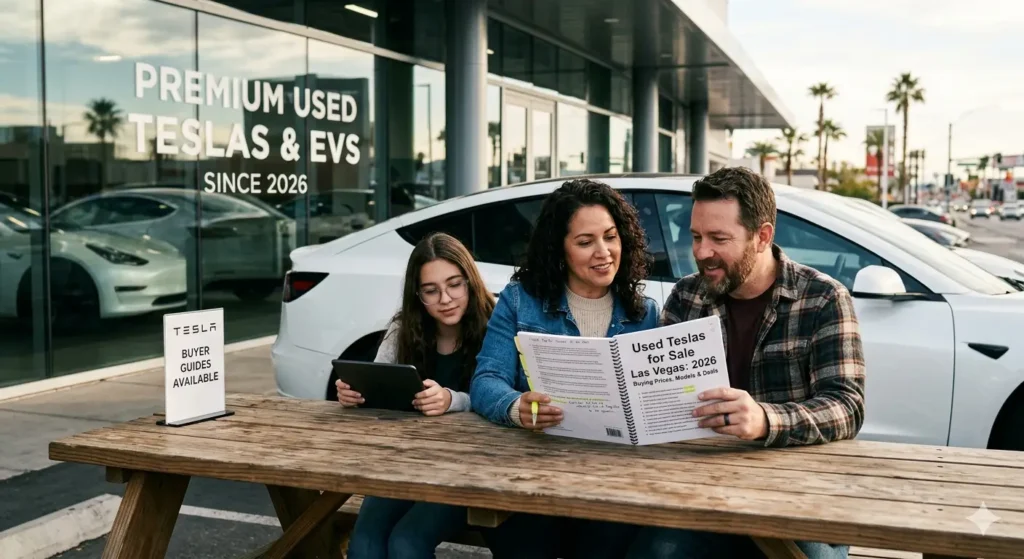
Buying a Used Tesla in Las Vegas: What the Desert Heat Actually Does
Las Vegas has quietly become one of the better U.S. markets to shop for a used Tesla — strong charging infrastructure, plenty of inventory, and year-round driving weather. But that same desert climate that makes Vegas easy to live in is genuinely tough on the one component that determines most of a used Tesla’s value: the battery. Here’s what to actually check before buying, not just what to expect from the shopping experience.
Why Vegas Specifically Changes the Calculation
Lithium-ion batteries don’t mind cold nearly as much as people assume — cold temporarily reduces range but does little lasting damage once the pack warms back up. Heat is the real long-term enemy, and it causes permanent, irreversible capacity loss rather than a temporary dip. A car that’s spent years parked outdoors in Las Vegas summers, especially without a garage, has been through meaningfully more thermal stress than the same model and mileage from a milder climate.
The numbers back this up clearly: a Tesla in a hot climate with heavy fast-charging use can show degradation rates approaching 3% per year, versus roughly 1.5% in a mild climate with mostly home charging. Applied over 100,000 miles, that’s the difference between a battery sitting comfortably above 90% of its original capacity and one dipping toward 80% — a real difference in both remaining range and resale value.
What to Actually Ask the Seller
Before you even look at a car in person, get specific about its history rather than just its mileage:
- Was it garaged, or parked outdoors? A car that’s spent its life in a covered garage will have aged noticeably better than an identical car parked in direct desert sun daily.
- How often was it fast-charged versus charged at home? Frequent Supercharger use generates more heat cycling on the pack than slow overnight home charging, and heavy DC fast-charging on top of a hot climate compounds the degradation rate.
- What state of charge was it typically kept at? Tesla recommends keeping daily charge between roughly 20% and 80% — a car that was regularly charged to 100% and driven down near empty has seen more cell stress than one kept in that middle range.
None of this is disqualifying on its own, but it should factor directly into what you’re willing to pay.
Get an Actual Battery Health Reading, Not Just an Odometer Check
Mileage alone tells you surprisingly little about a used Tesla’s real condition — a lower-mileage car that sat in extreme heat can have worse battery health than a higher-mileage car from a mild climate with careful charging habits. What you actually want is the battery’s state of health (SoH), which requires either a professional inspection using diagnostic tools that read the battery management system directly, or a documented range test comparing the car’s current rated range against its original EPA figure.
As a rough benchmark, most healthy Teslas retain somewhere between 85% and 95% of original capacity even after 50,000 to 100,000 miles. If a Vegas-market car is showing meaningfully below that — say, under 85% — without a price that reflects it, that’s a red flag worth walking away from rather than negotiating around.
Model-Specific Notes Worth Knowing
Not every Tesla model carries the same risk profile on the used market, independent of climate:
- Pre-2019 vehicles generally carry more risk across the board — older battery chemistry degrades faster, and Autopilot hardware from that era is now outdated relative to newer software features.
- Early Model S and Model X (roughly 2016–2019) have documented histories of suspension issues and, on the X specifically, complications with the falcon-wing doors and air suspension system. If shopping this generation, target 2020 or newer where possible.
- Model 3 and Model Y, especially Standard Range variants using LFP battery chemistry (common from 2023 onward), tend to show flatter, more predictable degradation curves early on, making them a comparatively safer bet in a hot-climate market like Vegas.
Bottom Line
A used Tesla from Las Vegas isn’t automatically a bad buy — but it deserves a more skeptical look at battery health than the same car from a temperate climate would. Ask directly about garage access and charging habits, insist on a real state-of-health reading rather than trusting mileage alone, and price any below-average battery health into your offer rather than assuming a clean CarFax tells the whole story.
FAQs
Can Tesla battery degradation be reversed or fixed with a software update? No — capacity loss from heat and age is a permanent electrochemical process; software can only help manage the rate of future degradation, not restore what’s already lost.
Is a Tesla with 60,000 miles automatically going to have a worse battery than one with 20,000? Not necessarily — climate history and charging habits often matter more than raw mileage, which is why a proper state-of-health check matters more than the odometer reading alone.
Does parking outside in Vegas summer really make a measurable difference? Yes — sustained heat exposure without shade or garage access is one of the most consistently cited accelerants of long-term battery aging across independent studies and owner data.