Vehicle Tracking Systems Safety Location and Fleet Management
A vehicle tracking system answers one question instantly: where is it right now? Using GPS and mobile networks, it beams a vehicle’s exact location to a phone or computer in real time. Parents use it to check on a teen driver, businesses use it to run entire fleets efficiently, and police use it to recover stolen cars faster. What started as a niche fleet tool has become a mainstream safety feature for anyone who wants peace of mind about a vehicle they can’t personally keep an eye on.
How It Actually Works
Underneath the simple app interface sits a fairly straightforward chain of technology. A small GPS device installed in the vehicle picks up signals from orbiting satellites and calculates the vehicle’s precise position. That data then travels over a mobile network to a server, which pushes it to an app or website the owner checks whenever they want.
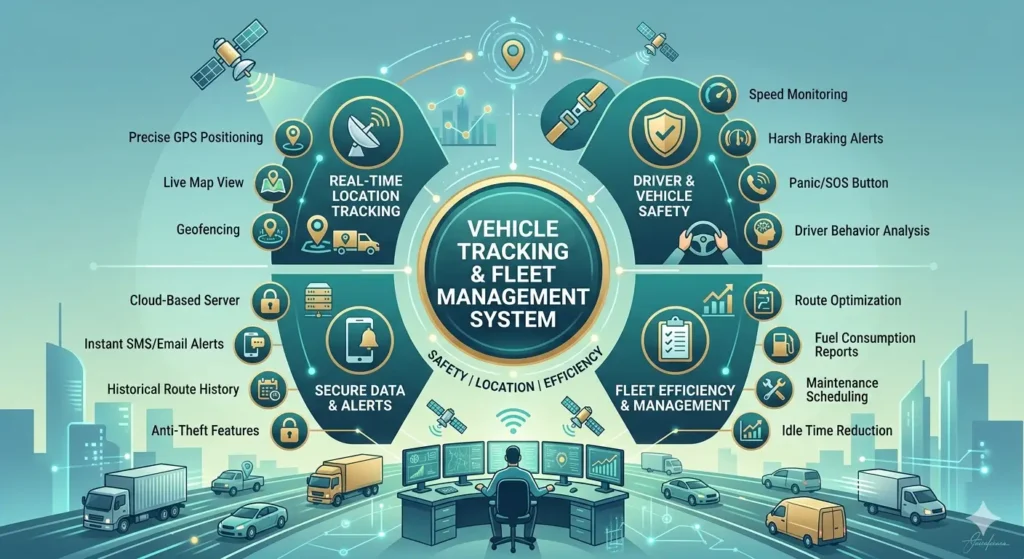
From that single screen, an owner can see the vehicle’s current location, its full travel route, how fast it’s moving, where it has stopped, and a complete history of past trips — all updated continuously rather than logged once a day.
Three Ways Systems Handle Tracking
Not every tracking system works the same way, and the differences matter depending on what you need.
Real-time systems stream live location data as the vehicle moves, which makes them the go-to choice for businesses that need to respond quickly — dispatching the nearest driver, monitoring a delivery in progress, or reacting fast if a vehicle goes off-route unexpectedly.
Passive systems take a cheaper approach: they store trip data and let you review it later rather than streaming it live. For someone who just wants route history and doesn’t need second-by-second updates, this option costs less and sets up in minutes.
Hybrid systems blend both, offering live tracking alongside a saved record of everything that happened. Larger companies tend to gravitate toward this option since it covers both immediate response and long-term reporting in one package.
What You’re Actually Paying For
A vehicle tracking system earns its cost back in several concrete ways. It improves security by making stolen vehicles far easier to locate — police can act on real location data instead of guesswork, which meaningfully boosts recovery odds. It cuts fuel costs, since drivers and dispatchers can pick shorter, smarter routes instead of relying on habit or traffic guesswork. It speeds up emergency response, since responders know exactly where a vehicle sits rather than searching blind. And for businesses running deliveries or field service, better route planning directly translates into faster jobs and happier customers.
Built for Fleets, Built for Families — Different Reasons, Same Technology
A delivery company might track fifty trucks at once, using the data to spot which routes waste time, which drivers idle too long, and when a vehicle needs maintenance before it breaks down mid-shift. That kind of visibility turns a chaotic fleet into a predictable, manageable operation — better scheduling, lower fuel bills, and service that actually shows up on time.
A family uses the exact same underlying technology for a completely different reason. Parents check where a teen driver has gone, locate a car in a packed parking garage, and get an instant alert the moment a vehicle moves somewhere it shouldn’t. The tools are identical; only the stakes and scale differ.
Features That Separate a Good System From a Mediocre One
GPS accuracy sits at the core of everything — without it, nothing else on this list matters. Beyond that baseline, a few features make the real difference in day-to-day usefulness:
| Feature | What It Does |
|---|---|
| Mobile App Access | Check any vehicle’s status from anywhere, anytime |
| Route History | Stores and replays past trips for review |
| Speed Alerts | Flags dangerous or policy-breaking speeds |
| Geofencing | Sends alerts when a vehicle enters or leaves a set zone |
| Maintenance Reminders | Warns before service is overdue |
Geofencing in particular has quietly become one of the most useful features on this list — set a virtual boundary around a neighborhood, a job site, or a delivery zone, and get notified the instant a vehicle crosses it, no manual checking required.
Recovering a Stolen Vehicle
When a vehicle goes missing, tracking systems turn a stressful scramble into a fairly mechanical process. The owner opens the app, the last known (or live) location shows up on the map, that information gets passed to authorities, and recovery efforts start immediately instead of after hours of uncertainty. Vehicles fitted with tracking systems consistently get recovered faster than those without, simply because there’s no guesswork involved in where to look.
Picking the Right System
Start with a realistic budget, since prices vary widely between basic passive trackers and full real-time fleet platforms. From there, match features to what you’ll genuinely use — a family checking on one car doesn’t need enterprise fleet-reporting tools, and paying for them just adds cost without adding value.
Beyond price and features, pay attention to the practical stuff: how simple the app actually is to use day-to-day, how responsive customer support is when something goes wrong, and what real users say in reviews rather than what the marketing page promises.
Common Uses Across Different Groups
Vehicle tracking has spread well beyond its original fleet-management roots. Families use it for everyday safety and peace of mind. Delivery and taxi businesses use it to run operations efficiently. Rental companies use it to protect their vehicles. Construction firms track equipment scattered across job sites, and school districts use it to monitor bus routes and arrival times for parents waiting at home.
Where This Technology Is Headed
Tracking systems keep getting sharper. Expect smarter alerts that filter out noise and flag only what actually matters, more detailed and accurate maps, better fuel-use reporting that ties directly into cost savings, and faster data updates that shrink the gap between something happening and an owner finding out about it. Both fleet operators and everyday families stand to benefit as the underlying technology keeps improving.
Mistakes Worth Avoiding
A few missteps show up again and again among first-time buyers: picking a system without comparing options first, skipping user reviews entirely, loading up on features that will never actually get used, letting the app’s software go unupdated, glossing over the real monthly subscription cost, and — for businesses especially — skipping driver training on how the system works. Each of these quietly erodes the value of an otherwise solid system.
The Bottom Line
Vehicle tracking systems solve a problem that used to have no good answer: knowing where a vehicle is when it’s out of sight. They tighten security, cut fuel costs, speed up emergency response, and make fleets genuinely easier to manage. Families get the same peace of mind on a smaller scale. As the technology keeps advancing, choosing the right system today means saving real time, money, and stress down the road.
Frequently Asked Questions
What exactly does a vehicle tracking system do? It shows a vehicle’s location — live or historical — through GPS and mobile network data sent to an app or website.
How does the tracking process actually work? A GPS device in the vehicle communicates with satellites, then sends that location data over a mobile network to your phone or computer.
Can these systems help recover a stolen vehicle? Yes — real-time location data lets owners and police act fast instead of searching blind.
Does a tracking system need an internet connection? Most rely on mobile networks to transmit data and an app or browser to display it.
Are vehicle tracking systems expensive? Cost depends heavily on the provider and feature set — passive systems run cheaper, real-time fleet platforms cost more.
Can parents track a family car or teen driver? Yes, this has become one of the most common uses for personal (non-fleet) tracking systems.
What does “real-time tracking” actually mean? It means the system streams a vehicle’s live location instantly, rather than storing it for later review.
Do businesses rely on these systems regularly? Extensively — fleet operators use them daily to manage routes, drivers, and maintenance schedules.
Can better tracking actually save fuel? Yes, smarter route planning based on tracking data measurably cuts fuel consumption over time.
Is the investment in a tracking system worth it? For most users, yes — the gains in safety, security, and operational efficiency generally outweigh the subscription cost.