
Exhaust Heat Wrap Worth the Mess, or Just Hype?
Pop the hood on a modified car and you’ll usually spot it — sections of the exhaust manifold wound in what looks like off-white bandage. It’s not cosmetic. Exhaust heat wrap is one of the cheapest ways to pull serious heat out of an engine bay, and it’s been a staple DIY mod for decades. But it’s also easy to do badly, and doing it badly can actually cause more harm than leaving the pipe bare.
The Physics, in Plain Terms
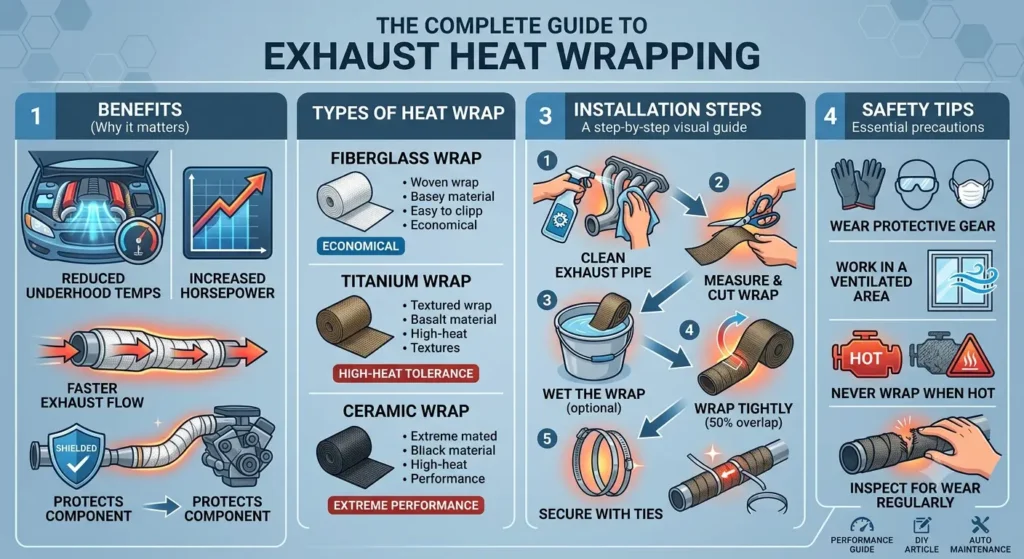
An exhaust manifold or header can hit temperatures north of 1,000°F under load. Left uncovered, that heat radiates outward into everything nearby — wiring, hoses, the intake tract, even paint on the inner fender. Wrap acts as insulation, keeping more of that heat inside the pipe instead of letting it escape into the engine bay.
There’s a secondary effect too: hot exhaust gas is less dense and moves faster. By keeping gas temperatures higher for longer as they travel down the pipe, wrap can slightly improve exhaust scavenging — the process of pulling spent gases out efficiently. It’s not a massive power gain on its own, but on a car where intake air temps matter (turbo setups especially), the cooler engine bay is often worth more than the exhaust-flow benefit itself.
Fiberglass vs. Titanium: What’s the Real Difference
Most wrap on the market falls into two camps:
Basic fiberglass wrap handles continuous heat around 1,200°F and brief spikes higher. It’s inexpensive and works fine for street cars and daily-driven setups. The tradeoff is that fiberglass holds moisture, and trapped moisture against hot metal accelerates rust — more on that below.
Titanium-coated or ceramic-treated wrap costs more but resists moisture retention far better and tolerates higher sustained temperatures. Worth it if the car sees track time, or if the exhaust runs in a tight bay with limited ventilation where heat soak is already a known issue.
There isn’t a “best” choice here so much as a right choice for how the car gets used.
Installing It Without Ruining Your Headers
This is the part most guides gloss over, and it’s the part that actually determines whether wrap helps or hurts long-term.
Start with a cold, disconnected exhaust. Obvious, but worth saying — burns from a “cool enough” header are a common shop injury.
Wet the wrap before applying it, unless the manufacturer specifically says not to. A damp wrap conforms tighter and shrinks slightly as it dries, which locks it against the pipe instead of leaving loose gaps where hot spots can form.
Overlap each wind by roughly a third to a half, working from one end steadily to the other — don’t skip around. Gaps in coverage create localized hot spots that can be worse than no wrap at all.
Don’t wrap it too tight. Compressing the fiberglass too hard reduces its insulating air pockets and can actually trap more heat against the metal than a properly loose wrap would.
Secure the ends with stainless ties, not the wrap material itself — the ends are where unraveling starts.
The Part Nobody Warns You About: Corrosion
Here’s the tradeoff that keeps this from being an obvious yes for every car. Wrap holds moisture — from rain, condensation, or just humid air — right against bare steel headers. On a header that isn’t coated (raw mild steel, not stainless or ceramic-coated), this traps moisture in constant contact with metal and can rust through a header in a fraction of the time it would take uncovered. Owners who wrap uncoated headers and then get surprised by cracked, rusted-out tubes a year or two later are one of the most common failure stories with this mod.
The fix is simple: wrap coated, stainless, or ceramic-coated headers when possible, or accept that you’re trading header longevity for thermal control on a raw steel setup.
Bottom Line
Exhaust wrap does what it claims — lower under-hood temps, marginally better exhaust flow, and it looks the part on a built engine bay. Just go in knowing it’s a maintenance tradeoff, not a install-and-forget upgrade. Check what your headers are made of before you buy a roll, and re-inspect the wrap periodically for the telltale rust staining that signals moisture is getting trapped underneath.
FAQs
Does exhaust wrap actually add horsepower? Modestly, and mostly indirectly — the real gain usually comes from lower intake air temperatures rather than the exhaust-flow effect itself.
Can I wrap a stainless steel exhaust safely? Yes, stainless holds up far better under wrap than raw mild steel, since it resists the moisture-trapped corrosion that affects unprotected metal.
How often should wrapped headers be checked? Roughly every 6–12 months, or sooner if you notice discoloration, a rust smell, or staining bleeding through the wrap.