
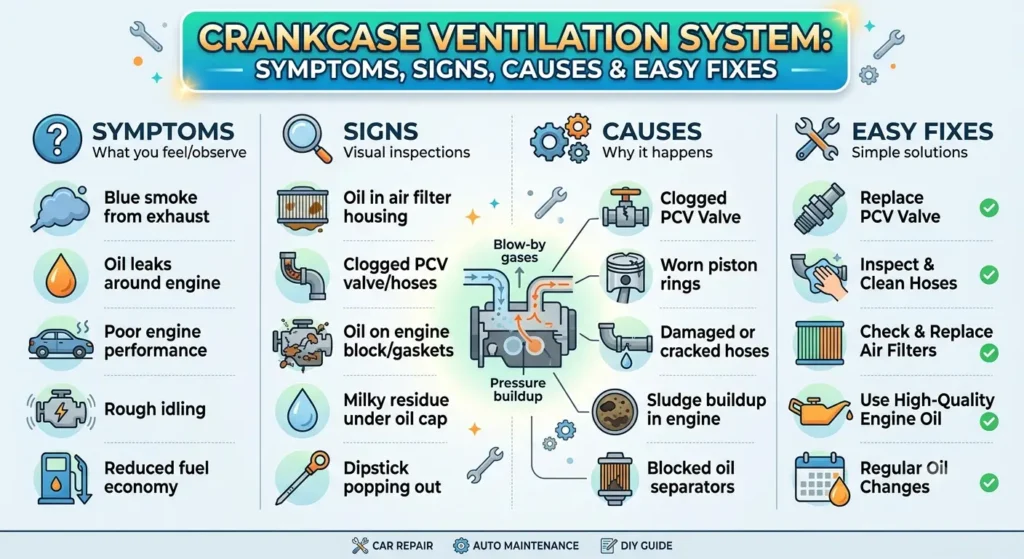
A Milky Oil Cap and a Rough Idle Might Be the Same Problem
If you’ve ever pulled the oil filler cap and found a pale, mayonnaise-like film clinging to the underside, that’s not a random gunk buildup — it’s usually your first visible sign that the crankcase ventilation system isn’t doing its job. This is one of those systems that quietly runs in the background of every engine and only gets attention once something’s already gone wrong.
What This System Is Actually Doing
Every time your engine fires, a small amount of combustion gas slips past the piston rings into the crankcase — the sealed area where your oil lives. This is called blow-by, and it’s completely normal in small amounts. Left unmanaged, though, it builds pressure inside the crankcase and mixes water vapor and unburned fuel into your oil.
The Positive Crankcase Ventilation (PCV) system exists to solve exactly this: it routes those gases out of the crankcase and back into the intake manifold, where they get burned off during normal combustion instead of building pressure or contaminating your oil supply. It’s been mandatory on production vehicles since the 1960s, largely because unmanaged crankcase venting was a genuine contributor to smog.
The Symptoms, and Why They’re Easy to Misread
A failing PCV valve or a clogged ventilation hose doesn’t announce itself clearly — it tends to mimic a handful of other common engine issues, which is why it often gets misdiagnosed.
A rough or unstable idle is one of the most common signs. A stuck-open PCV valve lets unmetered air into the intake, throwing off the air-fuel ratio right where the engine is most sensitive to it — at idle.
Oil in the air intake or on the air filter is a fairly definitive tell. If the system’s flow direction is reversed by a clog somewhere downstream, oil vapor gets pulled the wrong way and deposited where it shouldn’t be.
Milky residue under the oil cap or on the dipstick points to trapped moisture that isn’t being purged properly — condensation that would normally get vented out is instead emulsifying with the oil.
Rising oil consumption without a visible external leak often traces back here too, since a malfunctioning system can pull oil vapor into the combustion chamber to be burned off rather than returned to the sump.
A whistling or hissing noise from the engine bay, particularly noticeable at idle, can indicate a partial blockage creating unusual airflow through the valve.
Any one of these alone could point elsewhere — a rough idle especially has a dozen possible causes. It’s the combination, or persistence despite other fixes, that usually points back to the PCV system.
Quick Ways to Check It Yourself
You don’t need a shop visit to get a first read on this.
The rattle test: With the engine off, remove the PCV valve and shake it. A functioning valve rattles — you should hear a small internal component moving freely. Silence usually means it’s stuck, either open or closed.
Visual inspection of the hoses: Look for cracked, collapsed, or oil-soaked rubber lines running from the valve cover to the intake. These degrade with age and heat just like any other rubber hose under the hood.
Check the oil cap and dipstick for that milky residue mentioned above — it’s one of the easiest visual confirmations available without any tools.
If those checks come back clean but symptoms persist, a proper crankcase vacuum test at a shop can confirm whether the system is flowing correctly.
Why Ignoring It Costs More Later
A neglected PCV system doesn’t just cause a rough idle. Left long enough, the trapped pressure and moisture accelerate oil sludge buildup, degrade oil quality faster than normal service intervals account for, and in more severe cases, can push enough pressure through the system to blow out gaskets or seals that were otherwise fine. What starts as a cheap valve replacement can, ignored for long enough, turn into a much larger repair.
Bottom Line
The PCV valve itself is usually a low-cost part and a straightforward DIY swap on most engines. Check it during routine oil changes — pull it, give it a shake, glance at the hoses — and you’ll usually catch a failure well before it turns into anything more expensive.
FAQs
How often should a PCV valve be replaced? There’s no universal interval — many manufacturers don’t specify a fixed mileage, so checking it during oil changes and replacing at the first sign of sticking or symptoms is the practical approach.
Can a bad PCV valve trigger a check engine light? Yes, it can generate codes related to airflow or idle control, since it directly affects the air-fuel mixture the engine’s sensors are monitoring.
Is this the same thing as a CCV system? They’re closely related — PCV systems route gases back into the intake for combustion, while CCV (closed crankcase ventilation) uses a similar principle but is common on diesel and turbocharged engines with different routing and filtration.