
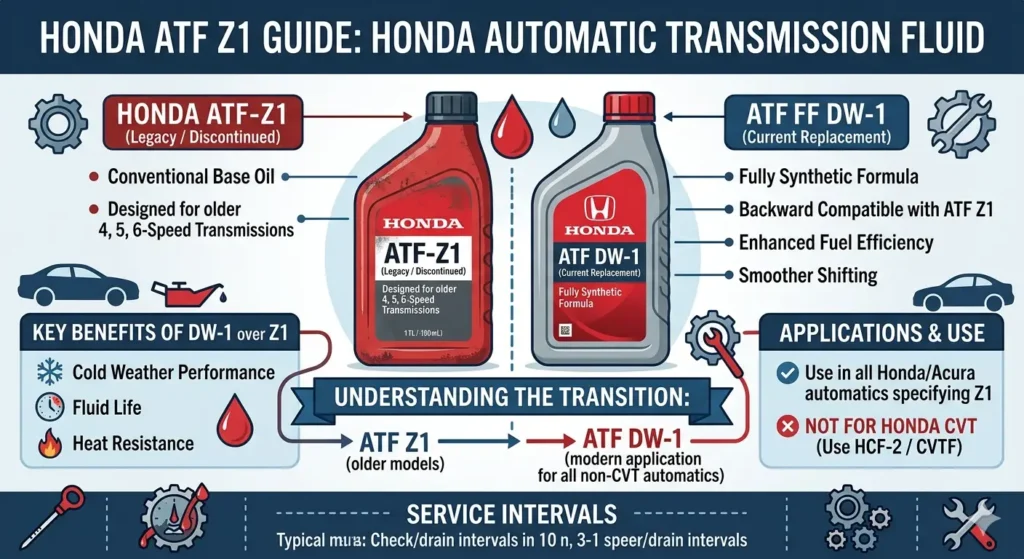
Honda ATF Z1 What It Was and What to Use Instead
Pop the hood on an older Honda and check the transmission fluid spec, and you might still see “ATF Z1” listed — even though Honda stopped producing it. That gap between what the manual says and what’s actually on shelves trips up a lot of owners, so it’s worth understanding what Z1 did, why Honda moved on from it, and what actually goes in the transmission now.
What ATF Z1 Actually Did
Automatic transmission fluid isn’t just lubrication — it’s the medium that transfers hydraulic pressure inside the transmission, keeps moving parts cool, and reduces the friction that would otherwise wear gears and clutch packs down faster than they should. ATF Z1 was Honda’s specific formulation for this job across a long run of automatic transmissions, engineered to match the particular clutch material and hydraulic pressures Honda used at the time. Using a generic fluid instead of Z1 in a transmission built around its specific friction characteristics could mean rougher shifts and faster wear — which is exactly why Honda kept such a tight spec on it.
Why Honda Replaced It
Honda DW-1 succeeded ATF Z1 as fluid technology and transmission designs moved forward. DW-1 isn’t just a rebrand — it’s formulated to hold up better in cold weather flow and offers meaningful improvements in overall performance compared to the older formula. For nearly every vehicle that originally specified Z1, Honda now recommends DW-1 as the direct replacement, which means most owners looking for Z1 today should be looking for DW-1 instead.
| Honda ATF Z1 | Honda DW-1 | |
|---|---|---|
| Status | Discontinued | Current standard |
| Cold-weather flow | Good | Better |
| Availability | Limited, hard to source | Widely available |
| Compatibility | Older Honda automatics | Replaces Z1 in nearly all cases |
Aftermarket fluids marketed as “Honda-compatible” also exist, but treat that label carefully — always confirm against your specific owner’s manual rather than assuming a bottle that says compatible actually meets Honda’s spec for your transmission.
Checking and Changing Fluid Correctly
Start with the owner’s manual, not memory or a forum post. Honda’s fluid recommendations are specific to model and year, and confirming the exact spec avoids guessing on something that directly affects transmission longevity.
Check the fluid level and condition before assuming a change is needed. Healthy transmission fluid should look relatively clean and bright — fluid that’s turned dark or carries a burnt smell is telling you something’s overdue, not necessarily that the fluid alone is the problem.
Work on a cooled vehicle. Transmission fluid straight out of a hot transmission can cause real burns, so give the car time to cool before you drain anything.
Dispose of old fluid properly, never on the ground or down a drain — most auto parts stores accept used transmission fluid for recycling at no cost, which makes there’s little excuse to dump it.
Where Owners Get This Wrong
The most common mistake is using whatever transmission fluid is on hand rather than confirming Honda’s actual spec — not all ATFs behave the same way inside a Honda transmission, and using the wrong one can show up as rough or delayed shifting. The second is ignoring the maintenance schedule altogether; fluid loses its protective properties over time even without a leak or an obvious problem. The third is overfilling during a change — too much fluid can create its own pressure and aeration issues inside the transmission, which is just as much a problem as running low.
The Bottom Line
If your Honda’s manual calls for ATF Z1, the practical answer today is Honda DW-1 — it’s the fluid Honda itself recommends as the replacement, and it’s what’s actually available. What matters more than which specific fluid name is on the bottle is confirming the current spec against your owner’s manual and staying on top of Honda’s maintenance intervals, since most transmission fluid problems trace back to skipped changes rather than the formula itself.
A couple of things people usually want to know:
Wrong transmission fluid can genuinely cause poor shifting and accelerated wear, so it’s not a detail worth guessing on. And if you’re unsure whether a change is overdue, dark or burnt-smelling fluid is usually a clear enough sign to check — that visual and smell test is a reliable first read even before you consult the maintenance schedule.