
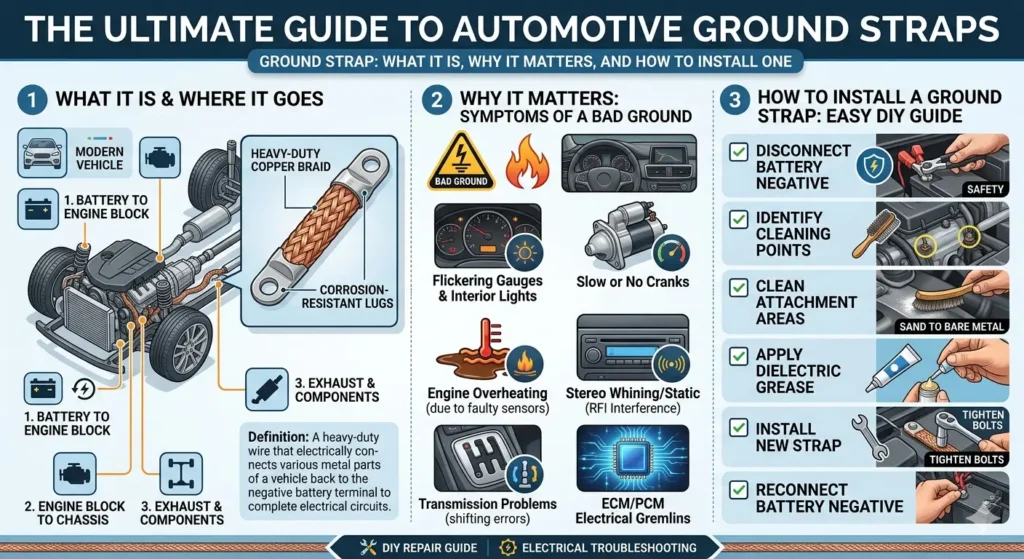
Why Your Ground Strap Matters More Than You Think
If your car has ever cranked slow for no clear reason, or your dash lights flicker when you hit a bump, don’t jump straight to the battery or alternator. Check the ground strap first — it’s the part nobody thinks about until it fails, and when it does, it can mimic half a dozen other electrical problems.
What a Ground Strap Actually Does
Every electrical circuit needs a return path back to the battery’s negative terminal — that’s the “ground.” In a car, metal components like the engine block, transmission, and body panels aren’t automatically connected to that ground just because they’re bolted together. Paint, rust, rubber mounts, and vibration all get in the way.
A ground strap is a short, heavy-gauge cable (usually braided copper or a solid cable, depending on the application) that bridges that gap deliberately. Most vehicles run several of them: one from the engine to the chassis, one from the battery to the body, sometimes one from the transmission to the frame. Each one is doing the same basic job — giving electricity a clean, low-resistance road home.
Think about it this way: your battery can push out plenty of power, but if the return path is corroded or loose, it’s like trying to breathe through a straw. The starter still turns, the lights still come on — just weaker, slower, and less consistently than they should.
How to Tell If Yours Is Failing
The tricky part with a bad ground strap is that the symptoms rarely point straight at it. Watch for:
- A starter that cranks noticeably slower than usual, especially in cold weather
- Headlights or dash lights that dim when you turn on the AC, radio, or other accessories
- Random electrical gremlins — power windows acting up, gauges flickering, a check engine light that comes and goes
- A car that stalls or misfires without an obvious mechanical cause
None of these are exclusive to a ground problem, which is exactly why mechanics check it early — it’s cheap and fast to rule out before chasing more expensive parts.
Checking and Replacing One Yourself
You don’t need a shop for this. Here’s the realistic process:
1. Disconnect the battery first. Always negative terminal first, positive last when you reconnect. This isn’t optional — skip it and you risk a short or a shock.
2. Find the straps. Look where the engine meets the frame, where the battery negative cable ends, and around the transmission-to-chassis area. They’re usually short, black or braided cables with a bolt on each end.
3. Inspect the connection points, not just the strap. A strap can look fine while the bolt underneath it is caked in corrosion. Wire-brush both surfaces down to bare, clean metal — corrosion is an insulator, and even a thin layer kills conductivity.
4. Test before you replace. If you have a multimeter, set it to DC volts, put one probe on the battery negative terminal and the other on the component you’re grounding (engine block, for example), and crank the engine. Anything over roughly 0.2–0.3 volts of “voltage drop” points to a bad ground.
5. Replace if needed, matching gauge and length. Don’t downsize the cable to save a few dollars — a thinner strap can’t carry the same current and will just fail again sooner.
A basic wrench set, a wire brush, and gloves cover most jobs. A multimeter turns this from guesswork into an actual diagnosis, and it’s worth owning one if you do your own maintenance regularly.
Where People Go Wrong
The most common mistake isn’t skipping maintenance — it’s cleaning the strap but not the mating surface underneath it, so the corrosion just comes back within months. The second most common mistake is reusing a bolt that’s already partially seized or stripped; a loose connection under vibration will loosen further over time, not stay put.
Bottom Line
A ground strap costs very little and takes maybe twenty minutes to inspect. If your electrical symptoms don’t add up to a clean explanation, this is one of the first — and cheapest — things worth ruling out before you start replacing bigger components.
FAQs
Can a bad ground strap actually prevent a car from starting? Yes — if resistance is high enough, the starter motor won’t get enough current to turn the engine over, even with a fully charged battery.
How long do ground straps typically last? Several years under normal conditions, but road salt, heat cycling near the exhaust, and constant vibration all shorten that lifespan.
Is a multimeter really necessary? Not strictly, but a voltage-drop test is the only reliable way to confirm a ground fault instead of guessing based on how a strap looks.