
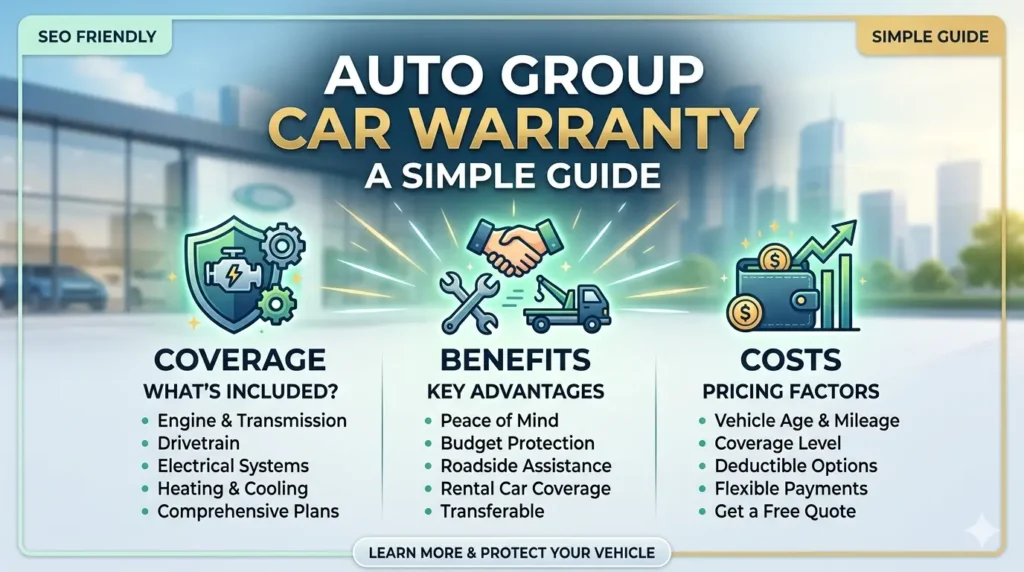
Auto Group Car Warranty What Coverage Actually Costs
Cars break down. It’s not a question of if, just when — and the parts that fail the most expensively are usually the ones you can’t see: the engine, the transmission, the electronics buried under the dash. An auto group car warranty exists for exactly that moment, paying part of the bill so you’re not covering a $3,000 repair entirely out of your own pocket.
But “warranty” is a loose word in this industry. One provider’s plan might cover forty components; another’s might cover twelve. Some pay out within days; others make you fight for every claim. This guide breaks down what these plans actually do, where the real costs and gaps hide, and how to pick one without getting burned.
So, What Is It Exactly?
Strip away the marketing, and an auto group car warranty is a repair-cost contract. You pay into it — monthly, yearly, or as a lump sum — and in exchange, the provider covers a share of approved repairs when a listed part fails. You’re usually still on the hook for a deductible.
The catch is that no two contracts read the same way. A plan that sounds “comprehensive” in an ad might exclude half the components you’d assume were covered. This is why the actual paperwork matters more than anything a salesperson tells you over the phone — read it before you sign, not after something breaks.
How a Claim Actually Plays Out
Say your transmission starts slipping. Here’s roughly what happens next:
- You take the car to a repair shop for diagnosis.
- The shop identifies the failed part and files a claim with your warranty provider.
- The provider reviews it and either approves or denies coverage.
- Once approved, the shop does the repair.
- The provider pays its agreed share; you cover the rest.
The part people trip over most is step three — approval has to happen before the repair starts in nearly every contract. Get the work done first and hope to be reimbursed later, and you may find yourself paying the entire bill yourself.
The Different Flavors of Coverage
Factory warranty comes free with most new cars and kicks in the day you drive off the lot, typically expiring after a set number of years or miles.
Powertrain warranty narrows in on the expensive stuff — engine, transmission, drivetrain — which is often enough protection on its own if those are the failures you’re worried about.
Extended warranty picks up where the factory coverage leaves off, which makes it popular with people who plan to hold onto a car well past its original warranty period.
Bumper-to-bumper warranty is the broadest of the bunch, but “broad” doesn’t mean “everything.” Certain parts are still excluded even on the most comprehensive plans, so don’t assume total coverage just because the name sounds like it.
What’s Usually In — and What’s Almost Never Included
Most plans cover the engine, transmission, cooling system, fuel system, electrical components, and steering. But routine wear items rarely make the cut: tires, brake pads, wiper blades, oil changes, cosmetic damage, and standard maintenance are excluded from nearly every contract on the market.
This gap trips up a lot of first-time buyers who assume “warranty” means “everything’s covered.” It doesn’t. Ask your provider for the full coverage list in writing before you commit to anything.
Why Bother Paying for One at All
The honest case for a warranty comes down to a few things. It softens the blow of a repair bill you didn’t see coming — a failed transmission can run into the thousands, and a warranty absorbs a real chunk of that. It also changes how you drive and plan: knowing help exists if something goes wrong takes some of the anxiety out of ownership, especially with an older car. And because repair costs are notoriously hard to predict, a warranty turns an unpredictable expense into something closer to a fixed monthly line item — which is genuinely easier to budget around.
What You’ll Actually Pay
Pricing isn’t fixed, and it depends heavily on your vehicle’s age, mileage, the coverage level you pick, contract length, and the make and model itself. Broader coverage costs more upfront, which is intuitive enough — but it can also save you more the first time something significant breaks. The only real way to know if you’re getting a fair price is to get quotes from a few providers and compare the actual numbers side by side, rather than judging a plan by its monthly price alone.
Picking a Plan Without Getting Burned
- Get quotes from more than one provider — prices and coverage vary more than you’d expect.
- Read the entire contract, not just the coverage summary page.
- Check the payout limits and your deductible on each claim.
- List out the exclusions specifically, in writing.
- Look up independent reviews, not just testimonials on the provider’s own site.
- Ask direct questions before signing — a provider that dodges specifics is a red flag.
At a Glance
| Feature | Details |
|---|---|
| Purpose | Covers a share of eligible repair costs |
| Coverage | Varies significantly by provider and plan |
| New cars | Usually protected by factory warranty first |
| Used cars | Often eligible for extended coverage |
| Repair approval | Required before work begins, in most contracts |
| Cost | Driven by vehicle age, mileage, and plan level |
| Contract length | Multiple term options, chosen at signup |
The Trade-Offs, Honestly
Warranties help absorb major repair costs and add real peace of mind, especially for anyone planning to keep a car long-term. They also make budgeting more predictable. On the other side, they’re a recurring cost, coverage limits and exclusions are common, not every repair will qualify, and the contracts themselves can be dense enough that people sign without fully understanding what they agreed to.
Mistakes Worth Avoiding
The buyers who end up disappointed almost always made one of the same handful of mistakes: they skipped reading the contract and trusted the sales pitch instead, ignored the exclusions list, picked the cheapest plan without comparing what it actually covered, didn’t keep maintenance records (which several providers require for a claim to go through), or simply assumed every repair would be covered when the contract said otherwise.
The Bottom Line
An auto group car warranty won’t make repair costs disappear, but it can meaningfully soften them — and that matters more the older your car gets. Since coverage differs so much between providers, the comparison itself is worth the time it takes. Pick a plan that actually fits your car’s age, mileage, and your own budget, and there’s a good chance it pays for itself the first time something expensive breaks.
Quick Questions, Straight Answers
Does it cover every repair? No — only what’s specifically listed in your contract.
Worth it for an older car? Often, yes, especially if repair costs are what worry you most about keeping it.
Can I get one for a used car? Yes, most used vehicles qualify for some form of extended coverage.
Are oil changes covered? No — routine maintenance is excluded from nearly every plan.
Can I transfer coverage to a new owner? Some providers allow it; check your specific contract.
Does mileage affect the price? Yes, higher mileage generally pushes the cost up.
How do I file a claim? Follow your provider’s exact process, and get approval before any repair work starts — that step is non-negotiable in most contracts.